-
Opportunity Youth: Disconnection, Persistence & The Path To Reconnection
Read more: Opportunity Youth: Disconnection, Persistence & The Path To ReconnectionKey Variables Of Advanced Prediction Of Disconnection In 2024, 510,727 young Californians between the ages of 16 and 24 – 10.8% of the age group, or roughly one in nine – were neither in school nor working. This report examines that population, the opportunity youth of California, drawing on five data sources to move beyond…
-

Southern Nevada’s Opportunity Youth Coalition Strategic Action Plan
Read more: Southern Nevada’s Opportunity Youth Coalition Strategic Action PlanDisrupting The Disconnected Youth Pipeline The Opportunity Youth Coalition (OYC) is a major systems-level effort led by Workforce Connections (WC), the Local Workforce Development Board for Southern Nevada, and over 30 key partners aimed at reconnecting youth ages 16 to 24 who are not in school or working. This population – often referred to as…
-

Challenges And Opportunities For Change
Read more: Challenges And Opportunities For ChangeAddressing Youth Disconnection In The Los Angeles Region This report is supported by the Alliance for Children’s Rights, the Conrad N. Hilton Foundation, The Aspen Forum for Community Solutions at the Aspen Institute, the Walter S. Johnson Foundation, and Stuart Foundation; and is conducted by New Ways to Work, a leading non-profit consulting firm specializing…
-

Update on Teen & Young Adult Disconnection In California
Read more: Update on Teen & Young Adult Disconnection In CaliforniaYouth disconnection, a term referring to individuals ages 16 to 24 who are neither in school nor at work, is a significant concern in California, across the country, and around the globe. In 2022, close to 525,000 teens and young adults in California were disconnected from education and employment, resulting in a disconnection rate of…
-

Updated Data on California’s Opportunity Youth
Read more: Updated Data on California’s Opportunity YouthAccording to the latest American Community Service data, taken in 2021, there are over 570,000 young people ages 16-24 in California who are disconnected from school and work. This represents 20% increase from 2019. In the evolving landscape of our modern economy, one of the most critical, yet often overlooked challenges we face is how…
-

Los Angeles County’s Out-of-Work & Disconnected Youth Data Report
Read more: Los Angeles County’s Out-of-Work & Disconnected Youth Data ReportThis brief paper serves as an update to the 2020 Los Angeles County Disconnected or (Opportunity) Youth report. According to data collected through the 2021 American Community Survey (ACS), there were just under 1.2 million 16-24-year-olds living in LA County, and 12.9% (~144,000) were neither in school nor at work. These data indicate a decrease…
-

California’s Opportunity Youth: 2022 Data Update
Read more: California’s Opportunity Youth: 2022 Data UpdateThe importance of engaging teens and young adults in education and employment opportunities is well documented and cannot be overstated, yet a significant number of 16-24-year-olds in California are disconnected from both. The short- and long-term consequences that stem from youth disconnection are varied – ranging from significant personal and social challenges to considerable losses…
-
The LA Story: Building A Workforce & Career Development System for Opportunity Youth
Read more: The LA Story: Building A Workforce & Career Development System for Opportunity YouthThis report shares the story of how two local coalitions with over 100 partners aligned their collective impact initiatives, resources, and skills to create systemic change in the Los Angeles region and captures the experience of efforts to increase access to and success in workforce and career development programs for opportunity youth (OY) those 16-to…
-

City of Los Angeles Opportunity Youth 2021 Data Report
Read more: City of Los Angeles Opportunity Youth 2021 Data ReportIn 2021, the City of Los Angeles (LA) was home to approximately 3.9 million people, making it the second most populous city in the country. Given its size, it is not surprising that LA is also home to the second largest population of teens and young adults (ages 16- 24) who are neither in school…
-

COYN Action Guide: Expanding Workforce & Career Development Pathways For Opportunity Youth
Read more: COYN Action Guide: Expanding Workforce & Career Development Pathways For Opportunity YouthA roadmap to expand access to and improve the quality of workforce and career development services provided for 16- to 24-year-old opportunity youth – defined as youth who are disconnected from both school and work as well as those who have experienced foster care, the justice system or homelessness. The frameworks themselves are intentionally ambitious…
-
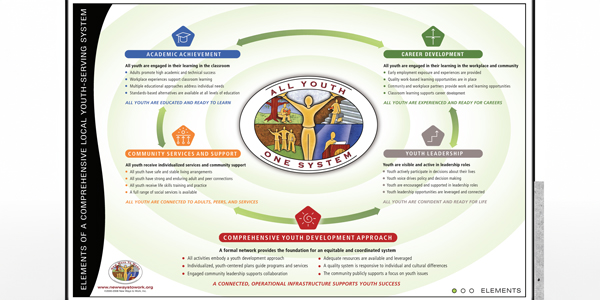
All Youth One System: Elements Of A Comprehensive, Youth-Serving System
Read more: All Youth One System: Elements Of A Comprehensive, Youth-Serving SystemThis framework guides partners in implementing the five elements of a comprehensive, youth-serving system. In a comprehensive and connected local youth system, programs, initiatives, and institutions work together to eliminate the duplication of services, maximize the impacts of multiple funding sources, and implement long-range plans to improve outcomes for the youth they serve. There is…
-

New Ways Milestones
Read more: New Ways MilestonesA historical account of the New Ways legacy from 1972 – 2007. New Ways to Work first opened its doors in 1972 as a 20 member collective concerned with issues facing women as they sought to combine work with raising a family. Throughout the seventies and eighties, New Ways promoted and helped define alternatives to…